
Table of Contents
ToggleThe Ultimate Guide to PPC(Pay Per Click) 5 Success
To be successful today, every business must find useful ways to reach its audience online. One successful approach to online marketing for driving qualified web traffic, generating leads, and growing your business’s sales is Pay-Per-Click (PPC) advertising.
Pay-Per-Click is an online advertisement method where advertisers pay a set amount every time a prospect clicks on their advertisement. As opposed to organically receiving visitor traffic to their websites, businesses can purchase qualified visitor web traffic from platforms like Google Ads and Microsoft Ads.
When a user does an online search for a product or service that relates to your business, your PPC advertisement may display as one of the first results shown in the search engine results pages, increasing your visibility and leading to more prospective customers.
Benefits of PPC advertising
- Instant Visibility — Unlike SEO where it may take many months before you see the results of your work, with a PPC campaign, you can start to see your advertisement beginning to generate web traffic shortly after it is turned on or launched.
- Targeted Audience Reach — PPC allows you to reach your target audience based on their expressed interest in your product or service through the types of keywords they use when searching for it; based on where they are located geographically; and based on their demographics (i.e., age, gender, household income, etc.), interests (i.e., whether or not they have children), and the type of device (computer, smart phone, etc.) they used to perform their search.
- Cost Control — Every business has a daily or monthly budget. With a PPC campaign, you set a daily limit on how much you are willing to pay for each click and only have to pay when a person actually clicks on your advertisement.
- Measurable Results — You are able to see in real-time how many people viewed your PPC campaign’s advertisement, how many people clicked on the advertisement, how many people who clicked on the advertisement turned into a lead, and how much of a return you have made from your investment in your PPC advertisement.
PPC Increased Conversion Rates
If you use the right strategy in your PPC campaigns, you will reach more high-intent users who are ready to buy something or to make an inquiry.
There are many key elements to successful PPC campaigns:
1) Keyword research – use tools to help identify the keywords used by your target audience.
2) Compelling ad copy – write headlines and descriptions that engage visitors.
3) Landing pages – build pages to encourage conversions through optimization.
4) Bid Management – establish bids on valuable keywords so your ad can show up when someone searches for it.
5) Performance Tracking – measure and track the performance of your campaign; make changes as needed.
Best Practices for PPC Success Include:
1) Focus on keywords with a high intent.
2) Use negative keywords to avoid irrelevant traffic.
3) Continually test ad variations.
4) Optimize landing pages for the visitor experience.
5) Monitor the performance of your campaign and adjust bidding accordingly.
PPC(Pay Per Click)
PPC Advertising is one of the fastest ways to create targeted traffic, lead generation and sales. A well-managed PPC campaign can help you meet your marketing objectives, no matter how big or small your company, while retaining control over your advertising budget. When combined with strategic keyword targeting, compelling ads, and continuous optimization of your PPC campaigns, you can achieve maximum ROI and remain competitive within your marketplace.
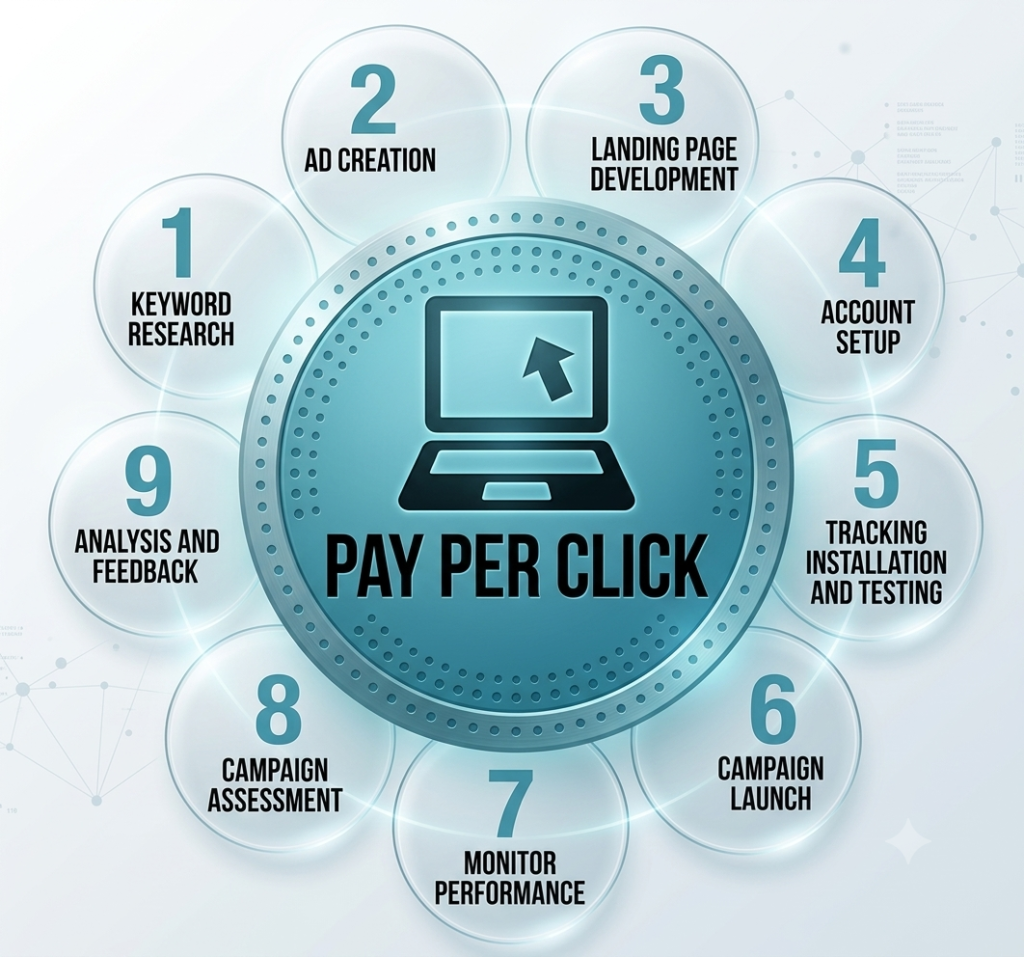
PPC relies on smart account structures and instant auctions. Success means using AI smart bidding, targeting intent-driven audiences, and analyzing competitor data to scale conversions.