
Table of Contents
ToggleGoogle Ads :Ultimate 9-Steps
Search Engine Marketing (SEM) is one of the most powerful ways to grow your online presence. It helps businesses appear prominently on search engine results pages (SERPs) when potential customers are actively looking for their products or services. The core goals of SEM are simple but impactful — attracting targeted traffic, generating quality leads, increasing conversions, building brand awareness, and ultimately driving more sales online.
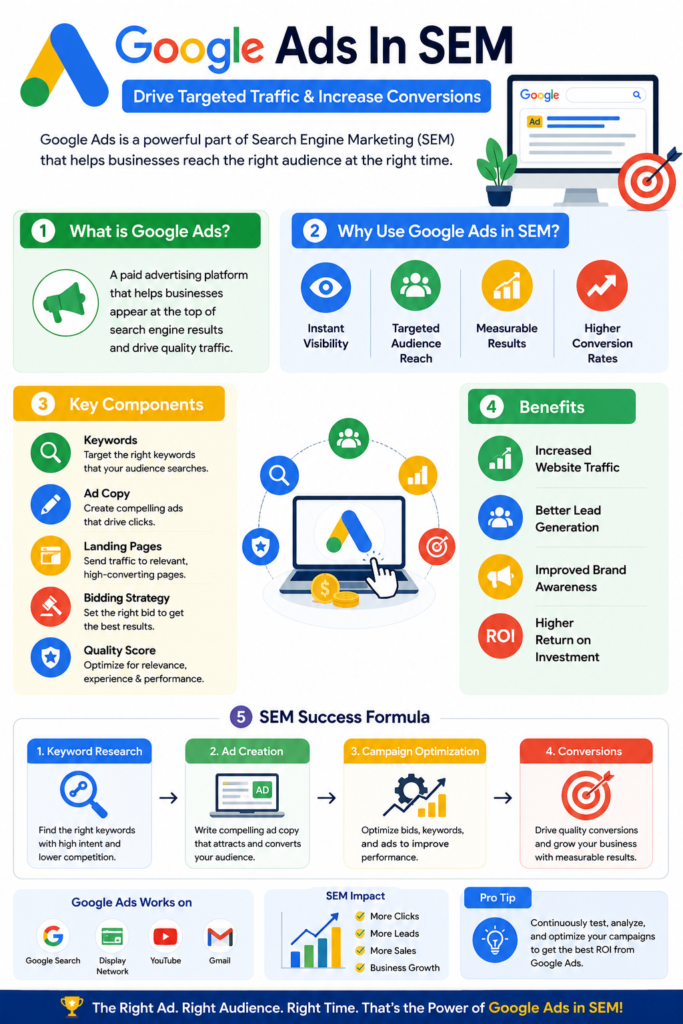
Among all SEM tools available today, Google Ads stands out as the most widely used platform, and for good reason. Google dominates the global search engine market, giving businesses access to an enormous audience. With Google Ads, your business can appear across Google Search, YouTube, the Google Display Network, Gmail, mobile applications, and Google Shopping. The platform operates primarily on a pay-per-click (PPC) model, meaning you only pay when someone actually clicks on your ad.
How Does Google Ads Work?
Every time a user performs a search, Google runs a real-time auction to decide which ads appear and in what order. Four key factors influence this decision. First, keywords — the phrases users type into the search bar — determine when your ad is eligible to show. Second, your bid amount sets the maximum you’re willing to pay per click. Third, your quality score reflects how relevant and useful your ad, keywords, and landing page are to the user. Finally, your ad rank — a combination of bid and quality score — determines your final position. A well-optimized ad can outrank a higher-budget competitor simply by being more relevant.
Types of Google Ads Campaigns
Google Ads offers five main campaign types, each designed for a different goal. Search campaigns display text ads in Google’s search results and work best for generating leads and reaching local customers. Display campaigns show image-based ads across websites, apps, and blogs in the Google Display Network, making them ideal for brand awareness and retargeting. Video campaigns run on YouTube and are perfect for product demonstrations and storytelling. Shopping campaigns display product images, prices, and store details directly in search results, making them the top choice for e-commerce businesses. App campaigns promote mobile applications across Google’s platforms to drive downloads and user engagement.
Key Metrics to Track
One of Google Ads’ biggest advantages is its measurability. The click-through rate (CTR) tells you how often people click your ad after seeing it, calculated as clicks divided by impressions. The cost per click (CPC) shows what you’re paying on average for each visit. The conversion rate reveals how many of those clicks turn into actual customers. Return on ad spend (ROAS) measures the revenue generated for every dollar spent on ads. Monitoring these metrics regularly helps you identify what’s working and where to improve.
Keyword Research and Match Types
Keyword research is the foundation of any successful Google Ads campaign. Choosing the right match type gives you control over who sees your ads. Broad match casts the widest net, showing ads for related searches — great for reach but less precise. Phrase match shows ads when the user’s search contains your exact phrase, offering a balance of reach and relevance. Exact match targets very specific searches, giving you the highest relevance and control. Negative keywords are equally important — they prevent your ads from appearing for irrelevant searches, protecting your budget from wasted clicks.
Tips for Creating Effective Ads
Writing great ads comes down to a few key principles. Start with a clear, benefit-driven headline that immediately speaks to what the user is looking for. Always include a strong call-to-action such as “Get started,” “Buy now,” or “Contact us today.” Make sure your landing page is fast, mobile-optimized, and directly relevant to your ad — a mismatch between your ad and landing page will hurt both your quality score and your conversions. Use ad extensions to add phone numbers, sitelinks, reviews, and location details, giving users more reasons to click. Finally, run A/B tests across multiple ad variations to continuously refine your messaging.
Common Mistakes to Avoid
Even experienced advertisers fall into predictable traps. Ignoring negative keywords is one of the most costly — it leads to paying for clicks from users who were never going to convert. Sending users to poor or generic landing pages wastes ad spend and frustrates potential customers. Not tracking conversions makes it impossible to measure ROI or make informed decisions. Over-relying on broad keywords attracts low-quality traffic and inflates costs. And forgetting to optimize for mobile is a serious oversight, since the majority of searches now happen on smartphones.
The Future of Google Ads
Google Ads is evolving rapidly. Artificial intelligence and automation are already transforming how campaigns are managed, with smart bidding strategies optimizing in real time. Audience targeting is becoming more sophisticated, allowing businesses to reach users based on behavior, intent, and interests. Voice search is also reshaping how people discover businesses online. Embracing these trends early will give advertisers a significant competitive edge.
Final Thoughts
Google Ads remains one of the most effective tools in digital marketing. Success comes from thorough keyword research, compelling ad copy, high-quality landing pages, and consistent monitoring and optimization. Whether you’re a small local business or a large e-commerce brand, Google Ads offers the scale, precision, and measurability to help you reach the right audience and grow your business.