
Table of Contents
ToggleSearch Engine Marketing (SEM): The Ultimate Guide for Your Online Business Success
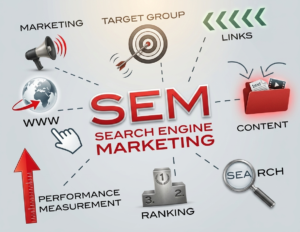
Today’s digital market is very competitive, and standing out from among millions of other websites is not easy. That’s why businesses need an approach that can provide fast results. In such cases, search engine marketing becomes a great solution.Google Ads in SEM
With SEM, businesses get listed on top of search engines and gain more traffic, leads, and sales.
What is Search Engine Marketing (SEM)?
Search Engine Marketing (SEM) is a digital marketing strategy that helps businesses increase their online visibility through paid advertisements on search engines like Google and Bing. Unlike Search Engine Optimization (SEO), which focuses on improving organic rankings over time, SEM delivers immediate visibility by displaying paid ads at the top of search engine results pages (SERPs).
SEM allows businesses to target users who are actively searching for specific products or services. By bidding on relevant keywords, advertisers can reach potential customers at the exact moment they are looking for solutions. This makes SEM one of the most effective methods for driving qualified traffic, generating leads, and increasing online sales.
How Does SEM Work?
SEM operates through a Pay-Per-Click (PPC) advertising model, where advertisers pay only when someone clicks on their ad. The process begins with keyword research to identify the search terms potential customers use.
When a user searches for a keyword, the search engine runs an ad auction. Factors such as the advertiser’s bid amount, ad quality, and landing page experience determine which ads appear and their position on the search results page.
A successful SEM campaign involves:
-
Selecting high-intent keywords
-
Creating compelling ad copy
-
Setting an appropriate budget
-
Optimizing landing pages
-
Monitoring campaign performance
Key Components of SEM:
Keyword Research
Keywords are the foundation of SEM. Businesses should choose keywords that match user intent and have the potential to generate relevant traffic.
Ad Copy
Effective advertisements use attention-grabbing headlines, clear descriptions, and strong calls-to-action (CTAs) to encourage users to click.
Landing Pages
A well-designed landing page should be relevant to the advertisement, load quickly, and provide a seamless user experience to maximize conversions.
Bidding Strategy
Advertisers decide how much they are willing to pay for each click. Google Ads offers manual and automated bidding strategies to help optimize campaign performance.
Quality Score
Search engines evaluate ads based on their relevance, expected click-through rate, and landing page experience. A higher Quality Score often results in lower advertising costs and better ad placement.
Benefits of Search Engine Marketing
SEM offers several advantages for businesses of all sizes.
-
Provides instant visibility on search engines
-
Reaches customers actively searching for products or services
-
Generates highly targeted traffic
-
Increases brand awareness
-
Offers measurable campaign performance
-
Provides flexible budgeting options
-
Delivers faster results than SEO
-
Improves lead generation and online sales
Because SEM targets users with strong purchase intent, it often produces higher conversion rates than many other digital marketing channels.
Popular SEM Platforms
Although several search engines offer advertising solutions, the most widely used platforms include:
-
Google Ads
-
Microsoft Advertising (Bing Ads)
-
Yahoo Search Ads
Among these, Google Ads dominates the market due to Google’s extensive global search engine usage.
SEM vs SEO
SEM and SEO are often used together but serve different purposes.
| Search Engine Marketing (SEM) | Search Engine Optimization (SEO) |
|---|---|
| Paid advertising | Organic optimization |
| Immediate results | Long-term results |
| Pay for every click | No advertising cost per click |
| Suitable for quick campaigns | Ideal for sustainable traffic |
| Budget-dependent | Content and optimization-driven |
Combining SEM and SEO creates a comprehensive digital marketing strategy that delivers both short-term and long-term growth.
Best Practices for SEM Success
To maximize return on investment (ROI), businesses should follow these best practices:
-
Conduct detailed keyword research
-
Use relevant and engaging ad copy
-
Optimize landing pages for conversions
-
Include ad extensions to improve visibility
-
Monitor campaign performance regularly
-
Perform A/B testing on advertisements
-
Use negative keywords to eliminate irrelevant traffic
-
Optimize campaigns for mobile users
Regular optimization helps reduce advertising costs while improving campaign effectiveness.
Conclusion
Search Engine Marketing (SEM) is one of the most powerful digital marketing strategies for businesses looking to increase their online presence and attract qualified customers. By combining keyword research, compelling advertisements, optimized landing pages, and continuous performance monitoring, businesses can achieve higher visibility, generate quality leads, and improve conversions.
Whether you are a small business, startup, or large enterprise, SEM provides a fast and measurable way to reach your target audience. When integrated with SEO and content marketing, it becomes an essential component of a successful digital marketing strategy, helping businesses achieve sustainable online growth and long-term success.